
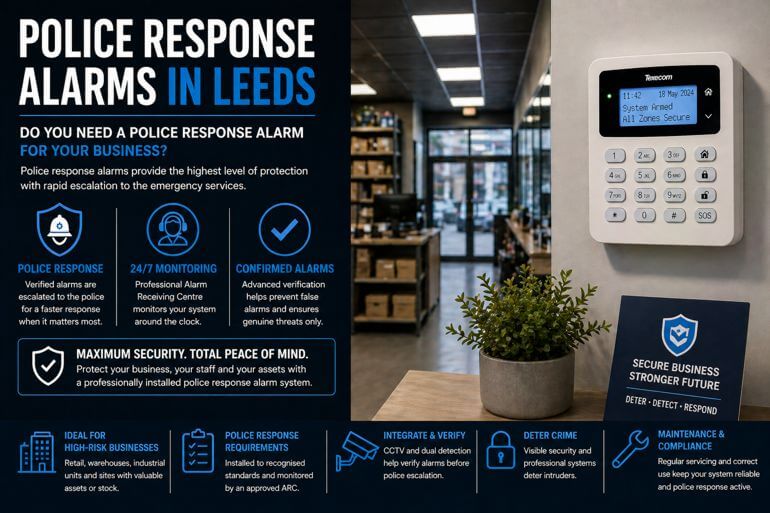
Leeds Police Response Alarm Guide –
If you run a business in Leeds, you may have come across the term “police response alarm” and wondered whether it’s necessary. It’s a common question — particularly for businesses with higher-value stock or increased risk — and one that requires a clear understanding of how these systems work and when they are appropriate.
What is a police response burglar alarm?
A police response alarm is a burglar alarm system that is authorised to request police attendance when activated. Unlike standard systems, which rely on local deterrence or keyholder response, these systems are linked to an Alarm Receiving Centre (ARC) and operate under strict guidelines.
When the alarm is triggered and verified, the ARC can escalate the incident to the police, resulting in a formal response.
Do all burglar alarms contact the police?
No — this is a common misconception.
Most standard burglar alarms:
- Sound an audible alarm
- Send alerts to users
- May notify keyholders
They do not automatically contact the police.
Only systems that meet specific requirements and are registered appropriately can request a police response.
What are the requirements for police response alarms?
To qualify for police response in Leeds, a system must typically:
- Be installed and maintained to recognised standards
- Be monitored by an approved Alarm Receiving Centre
- Have confirmed alarm activations (not single triggers)
- Be maintained under a service agreement
In addition, the system provider must meet recognised certification standards. This ensures that systems are reliable and that false alarms are minimised.
What is confirmed activation?
Police response systems rely on confirmed activations to reduce false callouts.
This usually means:
- Two separate detectors are triggered
or - A detector is triggered and then verified (e.g. via CCTV or sequential confirmation)
This process ensures that the alarm is likely to be genuine before escalation.
Which businesses in Leeds should consider police response alarms?
Police response alarms are most suitable for:
- Premises with high-value stock
- Warehouses and industrial units
- Retail businesses with theft risk
- Sites in higher-risk locations
For lower-risk premises, a monitored system without police response may still provide sufficient protection.
What are the benefits of a police response alarm?
The key advantages include:
- Faster escalation in genuine incidents
- Increased deterrence
- Higher level of protection for valuable assets
For Leeds businesses operating in competitive or high-risk sectors, this can provide an important layer of security.
Are there any downsides?
Police response alarms require strict compliance and ongoing management.
This includes:
- Regular maintenance
- Proper system use by staff
- Avoiding false alarms
Repeated false activations can result in response being withdrawn, so system reliability and correct operation are essential.
Is monitoring still important without police response?
Yes. Even without police escalation, monitored systems provide:
- 24/7 oversight
- Structured response via keyholders
- Immediate awareness of incidents
For many Leeds businesses, this level of protection is sufficient and more appropriate.
What’s the difference between monitored and police response alarms?
- Monitored alarm → ARC is notified and contacts keyholders
- Police response alarm → ARC can escalate directly to police (if criteria met)
Both offer strong protection — the difference is in the level of escalation.
Final Answer: Do you need a police response alarm in Leeds?
You may need a police response alarm if:
- Your business has a higher risk profile
- You store valuable goods or equipment
- You require rapid escalation to emergency services
For many businesses, a monitored alarm system provides an excellent level of protection without the additional requirements of police response.
The key is ensuring that the system is properly designed, professionally installed and suited to your specific risk level.